Written By: Greg Johnson
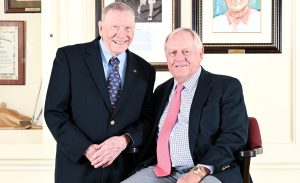
Jack Nicklaus, the best golfer Jack Berry said he ever witnessed and he witnessed them all seemingly, was at the grand opening of American Dunes Golf Club six years ago and was asked what he thought about Berry celebrating an 89th birthday.
“Jack Berry, 89, starting your 90th year, good gracious, Jack,” he exclaimed.
“I remember that little blonde kid that was out there just sort of trying to, you know, write newspaper articles and all those kinds of things. And all of a sudden, you turned out to be nine years older than I am. I don’t believe it.”
Nicklaus paused, grinned and decided to add a joke for fun.
“You know, we always used to say, you don’t look like you’re 89, Jack, but we all remember when you did,” he said and laughed.
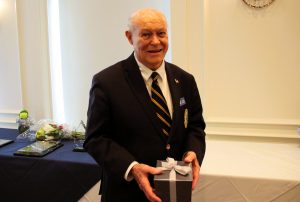
Jack Berry, a Michigan Golf Hall of Fame member, long-time writer for the Detroit News, well-known across the country as a leading golf writer and journalist, passed away Friday. He was 95.
Jack Berry, self-effacing always, enjoyed a good line or two and joked about himself just a year ago in reaction to birthday wishes from me.
“I’ve had a good life, a long life, and I’m surprised at the length of it,” he said and laughed. “It’s harder to remember it all, but I bet I saw a lot.”
He saw so much, though he missed the final round of the other Jack’s famous sixth Masters win in 1986. He was in the hospital and almost left us then. He made it through, though, and told me it wasn’t his final deadline just yet and that he had more stories to report.
That’s what he was – a true steadfast newspaper reporter of the highest degree.
And the things he reported will amaze you. Jack covered all the major Michigan sports teams, golf, and more.
He saw Nicklaus win at St. Andrews. He witnessed Watson and Trevino counting wins, including British Opens. He covered, too, the many majors at Oakland Hills. A young me asked him without thinking if he had covered Hogan at Oakland Hills in 1951. He bristled, “I’m not that old.”
Oh, but he was that good. He interviewed Hogan. He interviewed Snead and Byron Nelson and every golf legend you can name, even a young Tiger Woods.
Of course, he never forgot the state golf scene. The Michigan Women’s Golf Association has him in their hall of fame because of the impact his reporting made on women’s golf. The first time I played golf with him was in Charlevoix when we were covering the Michigan Amateur Championship at Belvedere in 1983, or ’84, not sure which. He knew the state’s golf pros. He was at the Michigan Open, the Michigan PGA Championship and always breaking stories wherever he went.
After his newspaper career, he wrote and went on camera reporting for years, in fact until just recently for Michigan Golfer’s massive collection of videos you can find on YouTube.
I think of him as a legendary golf writer. I was blessed to share a rental house with him and Terry Moore of Michigan Golfer fame at the Masters in Augusta, Ga., for several years, and remember so many wonderful conversations we shared.
Moore, a GAM Governor and chairman of the GAM’s Communications Committee these days, penned a truly heartfelt tribute to Jack. They were wonderful and inseparable friends. It’s a grand tribute, and we share it with you starting here:
Jack Berry: A Life Well Covered
By Terry Moore
Note: Jack Berry passed away on Oct. 16, 2026, at MediLodge, a rehab facility in West Bloomfield, MI. Two weeks ago, he suffered a bad fall at his apartment in Northville, sustaining head injuries from which he never recovered.
Jack Berry’s sportswriting career began in 1956 at Michigan State University (MSU), where he served as sports editor of The State News, the student newspaper. During his senior year, he became a stringer for United Press International (UPI), the syndicated news service. When UPI’s sports editor moved to the auto beat, the recently graduated Berry was asked to take over.
He covered just about everything: the Lions, the Tigers, and plenty of high school sports. “I lasted for three and a half years, and by then I swore I would sweep streets before I had to endure another State High School Tournament!” he recalled. But the experience taught him invaluable skills: how to write fast, write short, and dictate a story off the top of his head.
From UPI, Berry moved to the Detroit Free Press, where he met and learned from reporter Marshall Dann, who later became the longtime executive director of the Western Golf Association. “I hardly ever saw Dann in the office without a phone on his ear. He really covered his beats.” When Dann left the Free Press in 1961, Berry took over the golf and hockey coverage.
That year proved a baptism of fire. Michigan hosted the U.S. Open at Oakland Hills, won by Gene Littler; the Western Open at Blythefield Country Club, won by Arnold Palmer; and the U.S. Public Links Championship at Rackham, won by R.H. Sikes. All three tournaments took place within five weeks.
At Oakland Hills, Berry had his first encounter with the legendary, often curt Ben Hogan. Jack recalled meeting Hogan in the locker room on Tuesday. In his trademark gruff voice, Hogan’s first question was, “Hey, why weren’t there any golf stories in the paper today?”
Berry explained that he didn’t work Mondays, which accounted for the absence of golf coverage. Hogan wasn’t impressed. Fortunately, John Walter, the well-known golf writer for The Detroit News, was standing nearby and came to Berry’s defense.
Years later, Berry would succeed Walter at the News, where he established a national reputation of his own. In 1984, he was named president of the Golf Writers Association of America (GWAA), a prestigious position Walter had also held. As president, Berry was credited with urging Masters chairman Hord Hardin to lift the ban on female reporters entering the Masters locker room.
“Women are working as hard as the men and should be given the same access,” Berry argued. As the proud father of four daughters, he had good reason to champion equal treatment.
It was around this time that I became the founding editor of Michigan Golfer, a fledgling monthly newspaper devoted to covering golf throughout the state.
Publisher Art McCaffery and I met Jack for lunch and invited—implored, actually—him to become a monthly columnist, free to write about whatever caught his fancy. I knew that having a writer of Jack’s stature on our masthead would lend us instant credibility. It was a relief when he accepted. As we left the restaurant that day, I remember telling Art, “We’ll be OK; Jack Berry is with us.”
I learned so much from Jack. He was a generous mentor who showed me the ropes of golf journalism, including its politics and more challenging aspects. On more than one occasion, he came to my defense, just as Walter had once defended him in his encounter with Hogan.
We became frequent traveling companions, making trips to the Masters and several Ryder Cups, as well as overseas golf adventures in Ireland, Spain, and Finland. The golf was a delight, but the people we met and the places we discovered were what stayed with me most.
Whenever fellow golf writers saw me without my fellow Michigan golf writer, their first question was usually, “How’s Jack?”
I would bring them up to date on his latest adventures, whether he was competing in a marathon or heading to Broadway to see his beloved The Phantom of the Opera.
Rarely did anyone ask about his golf game. We all knew that was another matter. Jack hadn’t grown up playing sports, and taking up golf as an adult can be a challenge. (Here’s a little-known fact: Jack’s father was the traveling secretary for the Detroit Tigers. When the Tigers won the World Series in 1945, he received a full share of the players’ winnings—$6,400—which he used to pay off the family home.)
Still, Jack played briskly, and as long as a course lacked cross hazards, he could usually find his way around. Water, however, was his nemesis. At one memorable media day, the organizers embroidered an especially apt nickname on the back of Jack’s complimentary cap: AQUAPHOBE. Full disclosure: It was my idea.
Despite his aquatic anxieties, Jack recorded two holes-in-one and once won a trophy at the GWAA’s annual golf championship. For all the game’s frustrations and occasional embarrassments, he loved it.
Jack combined that passion with a reporter’s most valuable asset: curiosity. “I like finding out about someone or something and then writing about it,” he once told me. His UPI training served him well. He wrote quickly, wrote well, and rarely seemed to struggle with deadlines.
He also recognized how fortunate he had been to work for a major newspaper during the latter half of the 20th century before the internet transformed the business. In those days, people read daily newspapers, and their reporters and columnists were widely known and celebrated. In Michigan, everyone read Jack Berry.
And his beat extended well beyond golf. He covered Secretariat’s Triple Crown triumph at Belmont; Bo Schembechler and Michigan football; the “Miracle on Ice,” when the underdog U.S. hockey team won Olympic gold at Lake Placid; several Stanley Cup championships; and the Tigers’ 1968 World Series victory. He was also there for the tragic 1973 Indianapolis 500, when a driver and a pit sign holder were killed in separate incidents and dozens of spectators were later burned in a fiery explosion.
Yet golf remained his favorite sport to cover, in part because of the people it attracted. He once explained his preference this way: “Unlike some team sports I covered, golfers spoke in complete sentences and I didn’t have to bleep out anything.”
Jack was especially thoughtful and generous toward aspiring journalists. He always looked forward to interviewing students at MSU for the GWAA’s journalism scholarship. Several recipients went on to distinguished careers. Matt Rudy became a senior writer at Golf Digest; Melissa Sanchez became a reporter for ProPublica; and Nedra Pickler spent 17 years at the Associated Press, much of that time covering presidential campaigns and the White House.
Jack also championed young colleagues already working in the business. More than a few owed their next career opportunity to a strong recommendation from Berry.
Retirement from The Detroit News hardly meant slowing down. Jack remained active as secretary-treasurer of the GWAA, where he helped elevate the association’s annual awards dinner and ceremony during Masters week. He continued writing for Michigan Golfer and other golf publications.
At McCaffery’s urging, he also produced hundreds of YouTube videos, mostly featuring Michigan golf personalities and newsworthy events. Jack readily admitted that his on-camera presence wasn’t exactly “prime time” material. But his knowledge of his subjects and the questions he asked were invariably spot-on.
Until the end, Jack remained curious about the world around him. In his final column for The Detroit News, he wrote:
“My favorite colors are blue and green—blue sky and green grass. I’ve had my share of both. In newspapering, my favorite thing has been to find out what’s going on and write about it. Thanks for reading it.”
One of Jack’s favorite quotations came from John Walter, who once captured the appeal of golf writing in a question he posed to Berry: “Where can you go to so many nice places and meet so many nice people?”
It was a fitting description of Jack’s career—and perhaps of his life. He found his way into remarkable places, met fascinating people, told their stories, and helped others do the same. Along the way, he became a trusted colleague, a generous mentor, and a loyal friend.
In life’s meandering journey, aren’t we glad we met Jack Berry?
Berry is survived by his spouse, Bonnie Jean Humm, four daughters Anne Daugherty (Jerry), Susan, Karen Gebhardt (Sam), Jill, five grandchildren and two great-grandchildren.
Services for Berry will be sometime in November.